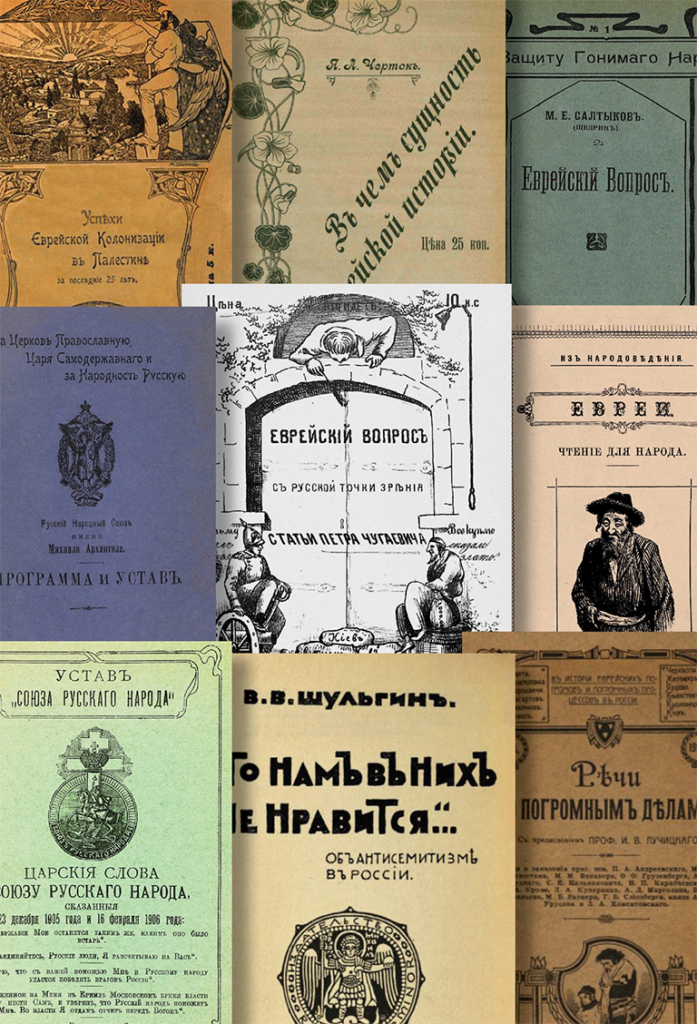
Jews in Imperial and Soviet Russia, 1824–1939
Key resource on more than a century of Jewish life across the Russian Empire and early Soviet Union
Jews in Imperial and Soviet Russia, 1824–1939 is a major digital primary-source collection bringing together over 450 rare and often difficult-to-obtain publications documenting more than a century of Jewish life across the Russian Empire and early Soviet Union. The collection combines substantial monographs and documentary works with government and legal publications, political pamphlets, statistical and demographic studies, organizational reports, ethnographic works, speeches, proceedings, and contemporary ephemera.
The collection is designed to present Russian and Soviet Jewish history in its full social and historical complexity. Major areas of coverage include Jewish legal status and civil rights; the Pale of Settlement; antisemitism, pogroms, and blood-libel trials; Jewish politics and labor movements; the Bund, Poale Zion, and Zionism; migration and emigration; population and economic conditions; agricultural settlement; religion and education; community welfare; culture and identity; regional Jewish communities; and Jewish historiography.
A particularly strong body of material covers the crisis decades from 1900 through 1917, when political mobilization, Zionism, socialism, revolutionary activity, and demands for civil and national rights coincided with pogroms, intensifying antisemitism, the Revolution of 1905, World War I, and the collapse of the imperial order. The collection documents such subjects as the Black Hundreds, the Kishinev and other pogroms, the Beilis Affair, Jewish representation in the State Duma, and debates over assimilation, national autonomy, labor activism, and emigration. The post-1917 materials extend the story into the early Soviet period, documenting the aftermath of Civil War violence, Soviet nationality policies, agricultural colonization projects, the transformation of Jewish communal institutions, changing economic and social conditions, and projects such as Birobidzhan. Read together with the imperial-era materials, these sources make it possible to study continuity and rupture across the revolutionary divide.
Geographic coverage reaches across Russia, Ukraine, Belarus, Lithuania, Poland, Bessarabia and Moldova, Siberia, the Caucasus, and other territories of the former Russian Empire and Soviet Union. Materials also reflect the wider international connections of Russian Jewry, including Palestine, Western Europe, the United States, China, and Manchuria. Presented as an integrated online research collection rather than a set of unrelated e-books, the database supports discovery across the collection through searchable text, detailed metadata, browsing, and faceted filtering. It is intended for research and teaching in Jewish Studies, Russian and East European Studies, modern European and Soviet history, political and social history, migration and diaspora studies, nationalism and minority studies, religious studies, legal history, and the history of antisemitism.