Kabul Times Digital Archive
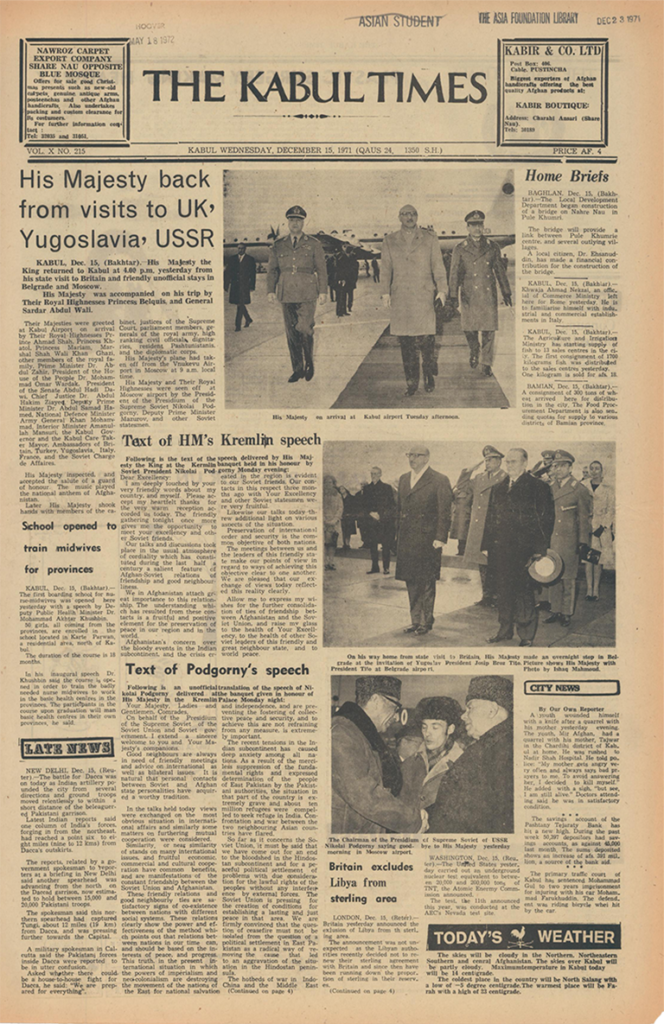
Founded as a state-sponsored daily, The Kabul Times functioned as the official voice for successive governments, targeting diplomats, expatriates, and the international community. This extensive collection allows researchers to track shifts in Afghan state bureaucracy across more than six decades of political upheaval. From the modernization initiatives of the 1960s monarchy to the Cold War dynamics of the 1970s and 1980s, the archive captures the evolving mechanisms of state power and national identity as presented to the English-speaking world.
Spanning a timeline defined by immense geopolitical volatility, the collection documents a succession of radically different political realities—including the Soviet intervention, the twenty-year Islamic Republic, and the Taliban takeover of 2021. The pages of The Kabul Times meticulously trace the country’s foreign policy maneuvers, economic transitions, and international relations through multiple systemic collapses and administrative rebuilds. Fully searchable and digitally preserved, this primary-source collection is an indispensable tool for historians and policy analysts studying the structural evolution of the Afghan state, its adaptation to decades of conflict, and its enduring position at the crossroads of global geopolitics.
Note: The Kabul Times is also available as part of the Afghan Central Press collection, with content from 1962-2023 only.