Titles in the Iranian Strategic Studies collection include:
Discourse: An Iranian Quarterly
Content from 1999-2020, in English
An English-language Iranian quarterly published from 1999 to 2020. Established and edited by Iranian academics, the journal sought to reduce what its inaugural issue described as a “conceptual gap” between the realities of contemporary Iranian society and the way Iran was often interpreted abroad.
The journal published scholarly articles, commentary, and book reviews on Iranian politics, society, economy, culture, foreign relations, and intellectual life. It aimed to provide international readers with perspectives rooted in Iranian academic discourse while presenting both the country’s achievements and its internal challenges. Regular coverage also highlighted developments in areas such as women and society, tourism, the arts, culture, economics, and domestic politics.
With more than two decades of English-language coverage, Discourse provides a useful record of how Iranian scholars sought to explain political and social developments in Iran to an international audience. It is particularly valuable for research in Iranian studies, political science, international relations, contemporary history, and the study of Iran’s external image and intellectual discourse.
Doctrines in the Persian Gulf: Persian Gulf and the New World Order
رهنامه خلیج فارس Rahnāmah-ʼi Khalīj-i Fārs, content from 2025, in Persian
Focuses on the politics, security, international relations, and political economy of the Persian Gulf. It covers Iran–U.S. relations, Gulf Arab diplomacy, U.S. regional policy, Israel and the Gulf states, energy and maritime security, political and economic change, and emerging strategic issues. Featuring contributions from Iranian and international scholars, the publication provides policy-oriented analysis of the Persian Gulf’s changing role in Middle Eastern and global affairs.
Iranian-Arab Affairs Quarterly
فصلية ايران والعرب Fasḷ ı̄ yat Ī rā n wa-al-ʻArab, content from 2002-2014, in Arabic with table of contents in Arabic, Persian and English
A scholarly journal published from 2002 to 2014 and devoted to relations between Iran and the Arab world. It examined political, strategic, economic, social, cultural, and historical issues, with particular attention to Iranian-Arab relations, regional diplomacy, foreign policy, energy, literature, and questions of identity and civilization.
Featuring contributions from Iranian and Arab scholars, the journal sought to encourage intellectual exchange across linguistic and national boundaries and to identify both areas of common interest and sources of tension between Iran and its Arab neighbors. Its coverage provides insight into how scholars in the region interpreted changing political relationships, cultural connections, and strategic developments during a period of major transformation in the Middle East.
With coverage spanning more than a decade, Iranian-Arab Affairs Quarterly is a useful source for research in Iranian studies, Arab studies, Middle Eastern politics, international relations, regional diplomacy, and contemporary intellectual and cultural history.
Middle East Affairs
شؤون الأوسط Shuʼū n al-Awsat, content from 1991, in Arabic, with table of contents in English
An Arabic-language journal devoted to political, strategic, economic, and social developments across the Middle East. Originally published monthly and later at a less frequent schedule, it offers scholarly and policy-oriented analysis of regional affairs, with particularly substantial coverage of Lebanon, Iran, Turkey, Israel and Palestine, and the wider Arab world.
The journal addresses such subjects as the Israeli-Palestinian conflict, regional security and diplomacy, Iranian politics and foreign policy, political Islam, democracy and political reform, relations between secular and religious movements, water and natural resources, globalization, gender and society, and the Palestinian diaspora. Its contributors include Arab scholars as well as Iranian and Western academics, with translated contributions providing perspectives from beyond the Arabic-speaking world.
With an archive extending back to 1991, Middle East Affairs provides a valuable record of the issues, debates, and geopolitical developments that have shaped Arab scholarly and strategic thinking over more than three decades. It is particularly useful for research in Middle Eastern studies, international relations, security studies, Arab politics, Iranian studies, and contemporary regional history.
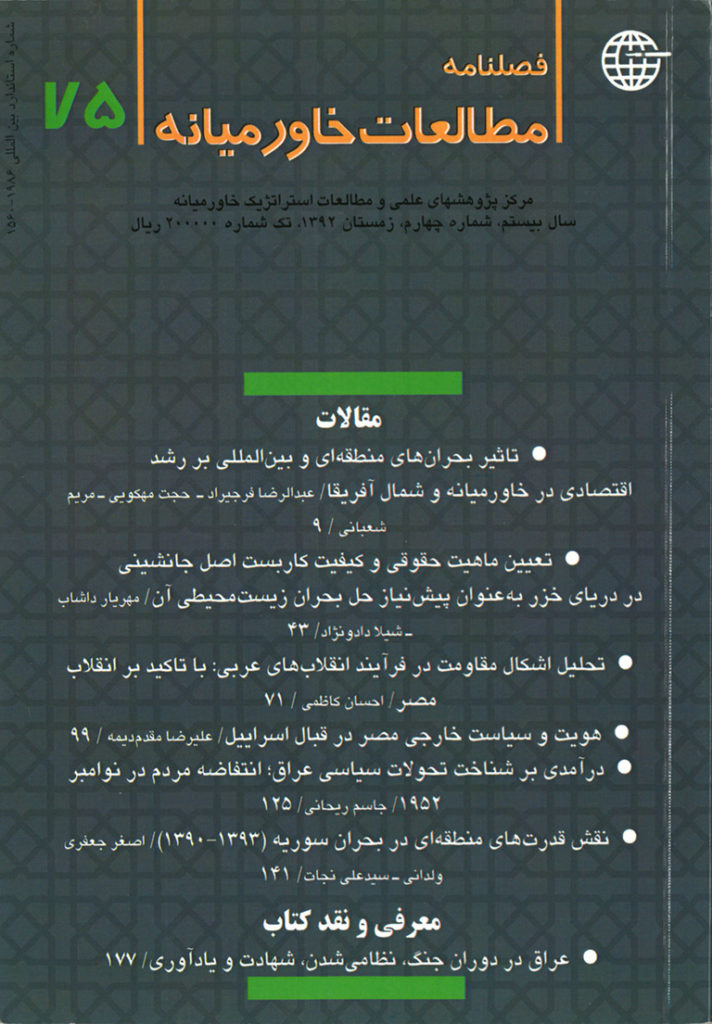
Middle East Studies Quarterly
فصلنامه مطالعات خاورميانه Fasḷ nā mah-i mutạ̄ laʻā t-i khā var-i miyā nah, content from 1994, in Persian, with table of contents and abstracts in English
Covers major themes in Iranian and Middle Eastern political and strategic studies, including Persian Gulf security, the Israeli-Palestinian conflict, U.S. foreign policy, Iran’s relations with international institutions, regional economic development, oil and gas, Central Asia and the Caucasus, North Africa, and the historical development of Islamic civilization. The journal also examines the impact of UN and IAEA decisions on Iran and broader questions of regional stability and international relations.
In addition to scholarly articles, the journal publishes roundtable summaries, conference proceedings, and book reviews, providing insight into the issues and debates shaping Iranian academic and policy discourse on the Middle East.
Regional Studies Quarterly: Israel-America Studies
فصلنامه مطالعات منطقه ای اسراييل شناسی–آمريکا شناسی Fasḷ nā mah-i mutạ̄ laʻā t-i mintạ qahʹı̄ -i Isrā yı̄ lʹshinā sı̄ Ā mrı̄ kā ʹshinā sı̄, content from 2000, in Persian, with table of contents and some abstracts in English
Focuses on the United States and Israel as two major subjects of Iranian strategic and political analysis. Rather than concentrating primarily on bilateral U.S.-Israel relations, the journal publishes separate studies of each country’s political system, society, foreign policy, security strategy, and role in the Middle East and international affairs.
Articles on the United States address topics such as Middle Eastern energy dependence, public diplomacy, American political parties and social structure, NATO and the Middle East, and U.S. relations with China and other major powers. Coverage of Israel places particular emphasis on defense policy, military and national security strategy, regional diplomacy, Zionism, and the historical and ideological foundations of the Israeli state.
Taken together, the journal provides insight into how Iranian scholars and policy analysts interpret the domestic and international behavior of the United States and Israel and their influence on regional politics and security.